MONGOLIAN KHÖÖMII: TIMBRE, MELODIES, AND REPERTOIRE
September 14 – 18, 2025
Aubagne
OBJECTIVE
To learn and improve:
• the timbre of Mongolian overtone singing (khöömii)
• a cappella overtone melodies
• repertoire that combines throat singing and overtone singing
For advanced participants: traditional instrumental accompaniment
GENERAL CONTENT
Did you know that everyone is capable of producing multiple sounds with a single voice? A khöömiich (Mongolian overtone singer) can, on their own, produce a vocal drone while simultaneously creating a harmonic melody surrounded by rich resonances. This vocal acrobatics may seem virtuosic, but it is accessible to all when taught properly. Anyone can be introduced to overtone singing (khöömii).
To explore the full scope of the khöömii technique, Johanni Curtet will be joined by Mongolian soloist Nemekhbayar Yadma. Throughout the workshop, they will provide both theoretical and practical elements drawn from their complementary approaches: one ethnomusicological, the other rooted in the traditional practice of the Mongols of the Altai region.
With this method, each participant can leave with a solid foundation to seriously develop the art of khöömii, while staying as close as possible to its traditional roots.
Nemekhbayar’s approach is deeply rooted in a family tradition from the Mongolian Altai, enriched by numerous creative experiences in traditional music.
SCHEDULE:
10:00 AM – 12:30 PM & 2:00 PM – 4:30 PM
PARTICIPATION REQUIREMENTS
Open to all (18+).
The masterclass is open to beginners for the first 2 or 3 days, and to advanced participants for the entire duration.
REGISTER NOW
>> ONLINE REGISTRATION <<
>> FEES AND REGISTRATION DETAILS <<
BIOGRAPHIES
Nemekhbayar YADMA
Born in 1991 in Naran Bulag, Uvs Province, Mongolia, Nemekhbayar studied traditional music, beginning with the khuuchir (the Mongolian equivalent of the Chinese erhu), at the Zavkhan College of Music and Dance for four years.
He worked as an orchestral musician at the Uliastai Drama Theatre from 2006 to 2007 and again from 2010 to 2015. In between, from 2007 to 2010, he held the same position at the Khovd Drama Theatre.
It was during this period that he met Sengedorj Nanjid—director of the theatre and one of the greatest professional khöömii masters—and began learning overtone singing under his guidance.
Since 2015, he has performed in Europe with the ensemble Hosoo-Transmongolia, and from 2019 onward with Argusan, his main ensemble, in which he is the lead overtone soloist, performing alongside Mandakhjargal Daansuren, a teacher at IIMM (International Institute of Mongolian Music).
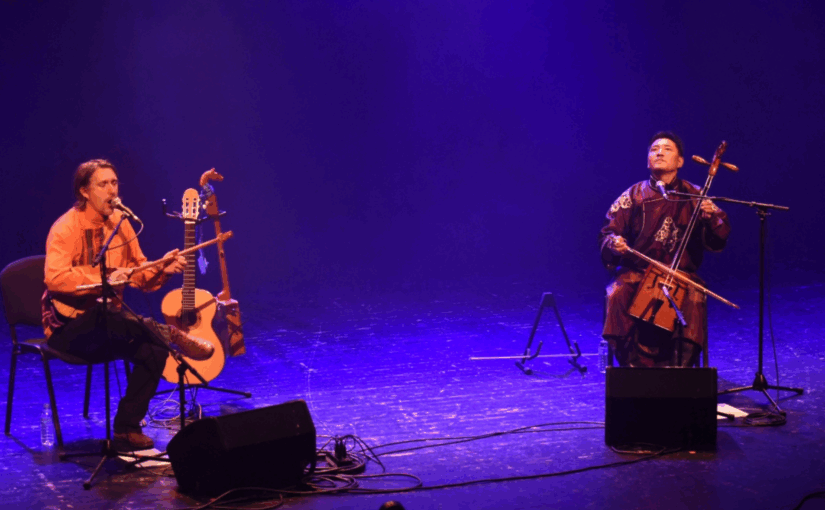
Since 2024, he also performs in a duo with Johanni Curtet.
To explore the practice of Mongolian khöömii, Nemekhbayar and Johanni will offer:
• exercises tailored for both beginners and experienced musicians
• instruction in both fundamental and advanced techniques
• focused work on developing a vocal timbre characteristic of the Mongolian style
• learning melodies and new repertoire related to throat singing for more advanced participants.
Johanni CURTET
Johanni Curtet is a musician, ethnomusicologist, overtone singing teacher, and producer. Initially trained by Trân Quang Hai, he later received traditional instruction from D. Tserendavaa in the Altai steppes and B. Odsüren at the University of Arts and Culture in Ulaanbaatar. He currently teaches khöömii at the Philharmonie de Paris and, in 2020, launched the first formal curriculum in the West dedicated to this art, at the International Institute of World Music (IIMM) in Aubagne.
He has also taught for institutions such as Le Pont Supérieur, DROM, ADEM, and the Equestrian Academy of Versailles, and led workshops at festivals like Les Suds in Arles and Les Orientales. His teaching spans professional musicians, amateur practitioners, and university students—most notably in 2017 during a tour of East Coast universities in the United States. In February and March 2020, he was invited for a residency at the University of Delaware in Newark as part of the “UD International Artist-in-Residence in Healing Arts” initiative.
Outside of his main trio, Meïkhâneh, he has performed with Tserendavaa & Tsogtgerel, Pierrick Lefranc’s Urbi&Orbi, Alain Basso’s electro-opera Èves Futures, Pierre Redon’s Ensemble 9, and Katajjaq et Khöömii, Chorus Nunavik / Mongolia, composed by Katia Makdissi-Warren for the Présence Autochtone festival in Montreal.
As a researcher, he lectures in ethnomusicology at Rennes 2 University. In 2010, he contributed to the inscription of Mongolian khöömii on UNESCO’s Representative List of the Intangible Cultural Heritage of Humanity. Following this, in 2017, he co-published with Nomindari Shagdarsuren a landmark recording: An Anthology of Mongolian Khöömii, which earned numerous accolades including ffff from Télérama, a “Coup de cœur” from the Académie Charles Cros, a spot in Le Monde’s Best Albums of 2017, Top of the World by Songlines magazine, and Best Album of 2017 for Central and East Asia by the Transglobal World Music Chart.
His musical journey is documented in two films by Jean-François Castell: Masters of Overtone Singing (2010) and Journey in Diphonia (2018).
Most recently, he composed his first film score for If Only I Could Hibernate by Mongolian director Zoljargal Purevdash, which was officially selected for the 2023 Cannes Film Festival in the “Un Certain Regard” section.