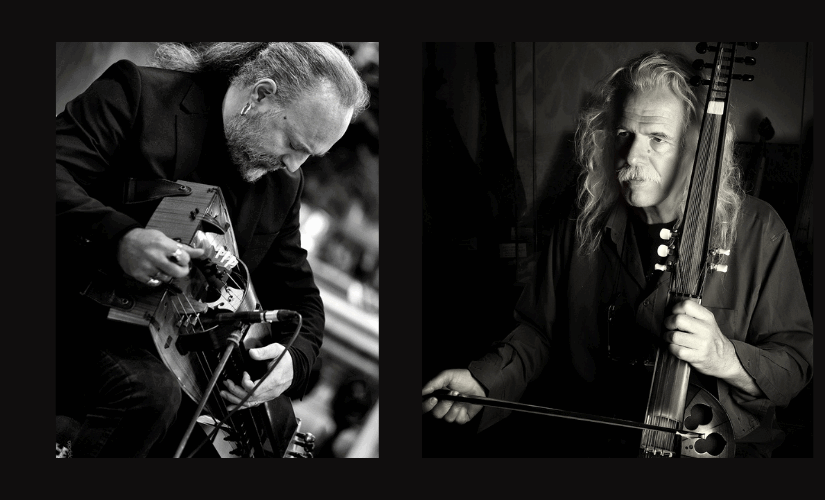
RECORDING AND SOUND PRODUCTION FOR ACOUSTIC INSTRUMENTS & CRETAN MUSICAL TRADITION
JULY 6–10, 2026: IN PARTNERSHIP WITH THE LABYRINTH MUSICAL WORKSHOP
CRETE – CHOUDETSI, HERAKLION
In partnership with Labyrinth
EFREN LOPEZ: JULY 6–8
OBJECTIVE
In this workshop, we will explore the entire creative and recording process in a home studio, from start to finish. This is particularly relevant today, as a large part of current commercial music production, as well as most pre-production demos, are carried out in home studios by musicians themselves.
GENERAL CONTENT
• Adapting everyday spaces for music recording
• How to plan a recording session
• Analysis and selection of the appropriate microphones for each instrument
• Microphone placement techniques
• Basic processing of voices and instruments: equalization, compression, and panning
• Main effects, their functions, parameters, and practical applications: reverb, delay, chorus, etc.
• Final mixing: creating layers, depth, and different sonic environments
• Basic mastering concepts
MUSICAL ASPECTS :
• Musical planning prior to recording
• Instrumentation and arrangements that work effectively in a production
The tools we will use are very simple: a laptop with Reaper DAW and a variety of microphones, equipment
that is accessible to almost any budget. We aim to demonstrate that, with a minimum of musical knowledge
and basic equipment, it is possible to achieve highly satisfactory results independently.
The workshop is intended for performers of all kinds of acoustic instruments, singers, and sound engineers
who wish to explore in depth the sound of instruments quite unusual within contemporary music production.
Throughout the workshop, we will approach the creative process as a whole, preparing the recording space
and recording our own arrangements of compositions that will be made available to participants beforehand
in the form of sheet music or audio files.
These arrangements will be adapted to the instruments and voices of the participants and will be recorded,
mixed, and mastered by the group during the workshop.
ROSS DALY: JULY 9–10
CRETAN MUSICAL TRADITIONS
OBJECTIVE
The aim of the seminar is not only musicological analysis, but also a deeper understanding of Cretan music as a living and evolving musical organism, shaped over centuries of exchange, transformation, and creative dialogue with broader modal traditions of the Eastern Mediterranean.
SPECIFIC OBJECTIVES
Cretan musical tradition is presented as a rich and living system, embedded in a cultural continuum linking the Eastern Mediterranean and the world of makam. The seminar examines its urban and rural forms, highlighting their aesthetic differences and social contexts. Particular attention is given to regional styles of Western, Central, and Eastern Crete, as well as their varying relationships to modality. Musical analysis focuses on phrasing, intonation, rhythmic structures, improvisation, and the evolution of older practices into modern forms influenced by Western music. The overall aim is to understand this music as an evolving organism, shaped by historical exchange and continuous transformation.
EDUCATIONAL CONTENT
The course will examine both urban and rural forms of the Cretan musical tradition, as well as the different aesthetic approaches developed in various social and geographical environments on the island.
Special attention will be given to urban musical styles of Crete, which often display more elaborate modal characteristics and closer affinities with the broader makam tradition, as well as to the rural repertoire, where older and deeper layers of local musical expression have often been preserved.
The distinctive musical idioms of Western, Central, and Eastern Crete will also be studied, each having developed its own aesthetic tendencies, instrumental techniques, phrasing styles, and relationship to modality. Some regional styles retain a stronger modal character, revealing clear affinities with Eastern makam traditions, while others show stronger influences from Western melodic and harmonic idioms introduced mainly over the past two centuries.
Through analysis and practical study of repertoires from different parts of the island, participants will examine issues such as phrasing, melodic development, intonation, interval structures, rhythmic organization, and the relationship between improvisation and fixed musical form. Particular importance will be given to the ways modal elements persist, transform, or disappear depending on historical periods and local idioms.
At the same time, the seminar will study the significant differences between older and contemporary Cretan repertoires. Attention will be given to how professionalization, recording technologies, mass media, urbanization, and changing aesthetic values have influenced musical style, structure, and function.
Special reference will be made to transformations in phrasing and melodic construction, the gradual emergence of more “Westernized” aesthetic tendencies in certain repertoires, and recent efforts to preserve or reconnect with older modal elements.
REQUIREMENTS :
• Participants who wish to take part in the recording sessions should bring one or more acoustic instruments
and/or be prepared to sing, in order to make the most efficient use of recording time.
• The musical pieces to be recorded should be well prepared and rehearsed
• Bringing your own equipment is not necessary, although participants who already work with Reaper may
find it useful to bring their own laptop and software setup.
Languages
English, Greek, Spanish, Catalan, French
More information: contact@iimm.fr
REGISTER NOW
>> ON-LINE REGISTRATION <<
>> RATES AND REGISTRATION PROCEDURE <<
BIOGRAPHIES
ROSS DALY
Long before the emergence of what we call “world music,” some individuals had already recognized the immense value and diversity of the world’s musical traditions and dedicated their lives to their study. One of these individuals is Ross Daly.
Although of Irish origin, Ross Daly does not fit into any particular ethnic stereotype, as his life has unfolded in many parts of the world and he has lived for over 35 years on the island of Crete, Greece. Early on, he discovered that music was, in his own words, “the language of my dialogue with what I perceive as sacred.”
This dialogue led him to the great modal traditions of the Middle East, Central Asia, and the Indian subcontinent, where he finally encountered the musical archetypes he had sought throughout his life. In these traditions, he encountered music that was not merely a vehicle for personal expression, but something capable of taking one beyond the usual boundaries of the self into other realms of transpersonal experience.
This discovery transformed Ross Daly’s life, and he abandoned all other activities to devote himself to studying the deepest secrets of these musical traditions and the art of composition. He traveled extensively, studying with leading masters of modal traditions worldwide. Since 1975, he has been based on the island of Crete, where he is widely recognized as one of the foremost experts on the island’s rich musical tradition.
He is also particularly known and respected for his ability to bring together artists from different and seemingly unrelated traditions into collaborations of unique quality and depth. In 1982, he founded the Labyrinth Musical Workshop, now located in the village of Houdetsi, 20 km south of Heraklion.
After many years of intensive training in various musical traditions, Ross Daly turned to composition, drawing on all the knowledge he acquired during his long apprenticeships. Today, he has released more than thirty-eight albums of his own compositions as well as arrangements of traditional melodies collected during his travels. The island of Crete remains a base for his personal and musical research, while he continues to travel worldwide to present his music.
Ross Daly has performed in many prestigious venues and festivals such as Carnegie Hall (2015), Migration Festival in Taipei (2006), International Lute Festival in Tetouan (2006), Madrid Summer Festival (2006), International Festival in Warsaw (2006), Manresa Festival in Barcelona (2006), Athens Concert Hall (1993, 2006), and the National Concert Hall in Dublin, among many others.
In the summer of 2004, he served as artistic director of the cultural program for the Olympic Games host city of Heraklion, Crete, titled “Crete, Music Crossroads.” He organized and supervised 15 concerts featuring 300 musicians from around the world, including internationally renowned artists such as Jordi Savall, Eduardo Niebla, Huun-Huur-Tu, Habil Aliev, Dhoad Gypsies of Rajasthan, Mohammad Rahim Khushnawaz, Trio Chemirani, Adel Salameh, and many others. Today, Ross Daly continues to travel and perform in Greece and abroad, while directing the Labyrinth Musical Workshop in Houdetsi.
EFRÉN LÓPEZ
Multi-instrumentalist · Composer · Producer · Sound Engineer
Specialized in the hurdy-gurdy and lutes from medieval European traditions, as well as those of the Eastern Mediterranean, the Middle East, and Central Asia.
For more than 30 years, Efrén López (Valencia, Spain, 1972) has participated as composer, performer, and/or producer in some of the most creative musical projects across both shores of the Mediterranean, the Middle East, Asia, and European medieval traditions: Jordi Savall & Hespèrion XXI, Ross Daly, Trio Petrakis López Chemirani, L’Ham de Foc, Stelios Petrakis, Kelly Thoma, Keyvan Chemirani, Katerina Papadopoulou, Derya Türkan, Dilek Türkan, Göksel Baktagir, Sima Bina, Zohar Fresco, Michalis Kouloumis, Azam Ali, Paloma Gutiérrez del Arroyo, Arianna Savall, Capella de Ministrers, Oni Wytars, Élèonore Fourniau, Sylvain Barou, Rocío Márquez, Carles Dénia, María del Mar Bonet, Lamia Yared, Yasamin Shahhosseini, Daud Khan, Parvathy Baul, Fernando Barroso, Germán Díaz, Ziya Tabasian, Nilgün Aksoy, Ertan Tekin, Veka Aler, Arslan Hasreti, Siamak Aghaei, Pedram Khavarzamini, Kourosh Ghazvineh, Bashir Faramarzi, E.A.R., 3,14, Elena Ledda, On, Noma Omran, Zohreh Jooya, Núria Rovira Salat, Faun, Al Firdaus, InTactvs, Eloqventia, Cabra, Armand Amar, Minco Eggersman, and Sandra Sangiao.
With these ensembles, he has performed at the most prestigious festivals in Europe, North Africa, North and South America, the Middle East, China, and the Indian subcontinent, and has participated in the recording of more than 100 CDs.
He has studied the techniques and theory of various instruments and musical systems of the Mediterranean, Middle East, and medieval music with Ross Daly, Erkan Oğur, Erol Parlak, Mehmet Erenler, Erdal Erzincan, Ömer Erdoğdular, Necati Çelik, Yurdal Tokcan, Daud Khan Sadozai, Mohammed Rahim Khushnawaz, Yasamin Shahhosseini, Keyvan Chemirani, Zohar Fresco, Isabel Martín, Araz Salek, Nigel Eaton, Maurizio Martinotti, Germán Díaz, and Pascal Lefèvre, among others. As a music educator, he has led workshops on medieval, traditional, modal music, and sound engineering at:
Berklee Music School in Valencia (Spain)
Labyrinth Music School in Crete (Greece)
Labyrinth Catalunya (Spain)
Labyrinth Online
ESMUC (Barcelona, Spain)
Ethnomusicology Workshops (Geneva, Switzerland)
Ruhnu Fiddle Festival (Estonia)
Fondation Royaumont (France)
Persian Music School (Malmö, Sweden)