KLEZMER MUSIC
FEBRUARY 25 – MARCH 1, 2026
AUBAGNE
GENERAL OBJECTIVE
Introduction and advanced study of various expressions of Klezmer, the traditional music of Eastern European Jews.
EDUCATIONAL CONTENT
Learning pieces from the repertoire:
Dances (for celebrations and festivities such as weddings, birthdays, bar/bat mitzvahs)
Nigunim (wordless spiritual songs)
Domestic songs (e.g. lullabies)
A few melodies drawn from Jewish liturgical prayers (e.g. Avinu Malkenu)
Study of Klezmer-specific technical and theoretical aspects:
Melody and its various variations
The flexibility of agogic phrasing (playing with tempo and timing)
Harmonizations and arrangements
Klezmer modes such as:
– Klezmer Major (Ahavah Rabbah)
– Klezmer Minor (Mi Sheberach)
– Mixolydian (Adonai Malakh)
– And other more traditional modes
– Ornaments: krekhts, glissandi, trills
-Typical melodic-rhythmic idioms of the Klezmer tradition
Various rhythmic styles:
– Hora (e.g. Gasn Nigun)
– Freylekh (e.g. Bukoviner Freylekh)
– Bulgar (e.g. Heyser Bulgar)
– Terkish (e.g. Der Yid in Yerushalayim or Terkishe Yale V’Yove Tantz)
– Khosidl (e.g. Khosidl by German Goldenshteyn)
Improvisation practice, for example during a Doina:
Modal improvisation
Using a drone (bourdon)
Introducing harmonic changes
General analysis of Klezmer music through listening and repertoire learning.
Participants may bring scores or audio files of pieces they wish to work on during the workshop.
Listening sessions:
-
Historic recordings:
Naftule Brandwein, Dave Tarras, Abe Schwartz, Belf’s Romanian Orchestra, A. Elenkrig’s Yidishe Orchestra, Lieut. Jos. Frankel’s Orchestra, State Ens. of Jewish Folk Music of Ukrainian SSR, S. Young’s Yiddisher Orchestra, Josef Solinski, Max Leibowitz, Menashe Oppenheim
-
More recent recordings:
Klezmatics, Brave Old World, Deborah Strauss, Chicago Klezmer Ensemble, Di Naye Kapelye, German Goldenshteyn, Zisl Slepovitch’s Litvakus, Steven Greenman, Pete Rushefsky and Jake Shulman-Ment
Comparison of modal systems and the influence of Western tonal harmony in current Klezmer arrangements
REGISTER NOW
>> ON-LINE REGISTRATION <<
>> RATES AND REGISTRATION PROCEDURE <<
REPERTOIRE CONTEXT
Klezmer music is the traditional music that Ashkenazi Jewish musicians (klezmorim) carried from celebration to celebration, from shtetl (village) to ghetto, throughout Eastern Europe, from the Middle Ages until the Nazi and Stalinist persecutions of the 20th century. It draws from both secular songs and popular dances.
Through contact with Slavic, Romani, Greek, Turkish musicians, and later jazz, Klezmer music developed a rich diversity and a distinctive sound, which today is appreciated around the world. The Klezmer and Yiddish repertoire invites audiences to dance and allows musicians to express the full range of human emotion—from joy to despair, piety to rebellion, contemplation to intoxication—not to mention Jewish humor and love.
Since the 21st century, special mention must be made of new trends that either incorporate Klezmer or claim inspiration from it: multiple fusions with contemporary Western music genres such as reggae, ska, hip-hop, drum’n’bass, disco, techno, house, rap, ragga, jungle, and more.
FIELDWORK & ARCHIVING
Collecting traditional material became an urgent mission as the generation of Holocaust survivors began to disappear—taking with it much of the Yiddishkeit (Jewish cultural identity).
From the 1970s, musicians and ethnomusicologists began the work of documenting and collecting, starting with institutions like YIVO in New York (Yiddish Institute for Jewish Research). Figures such as Zev Feldman conducted important fieldwork to gather material from the last remaining tradition bearers.
THE ROLE OF TRANSMISSION
Many Eastern European musicians emigrated to the United States to escape pogroms, such as Dave Tarras and Naftule Brandwein. They continued to play Klezmer music in the U.S. for their communities at Jewish life-cycle celebrations, and later also on stage.
Like all oral traditions, Klezmer music evolved, especially through its contact with jazz in the U.S., resulting in a unique style not found in Klezmer traditions that remained outside of the American context (e.g., German Goldenshteyn, before arriving in the U.S. in 1994).
Since then, many Klezmer collections and tune books have been published. However, they often lack the most essential elements—those which written notation cannot convey: style, phrasing, and more. These collections are valuable for discovering repertoire, but only if one already knows the style, or has reliable audio sources to refer to.
RE-TRANSMISSION
Transcription has its limits, as it is extremely difficult to write down the phrasing, style, and tempo, especially since the rhythm is often irregular (for example, the Klezmer hora falls somewhere between 3/4 and 5/8 time).
Ornaments are also hard to capture in notation—krekhts, trills (more or less tight), etc. Sheet music can serve as a memory aid or a way to discover new pieces, but oral learning remains essential.
PARTICIPATION REQUIREMENTS
Please note: this is an INSTRUMENTAL-ONLY workshop.
Open to all instruments and all levels, provided participants are comfortable with their instrument—no age restrictions.
You must know where the notes are on your instrument, feel confident playing, and be able to perform full melodies without difficulty (i.e., play a piece from beginning to end without stopping or struggling).
Participants are welcome to attend in groups, and may prepare pieces or arrangements in advance.
BIOGRAPHY
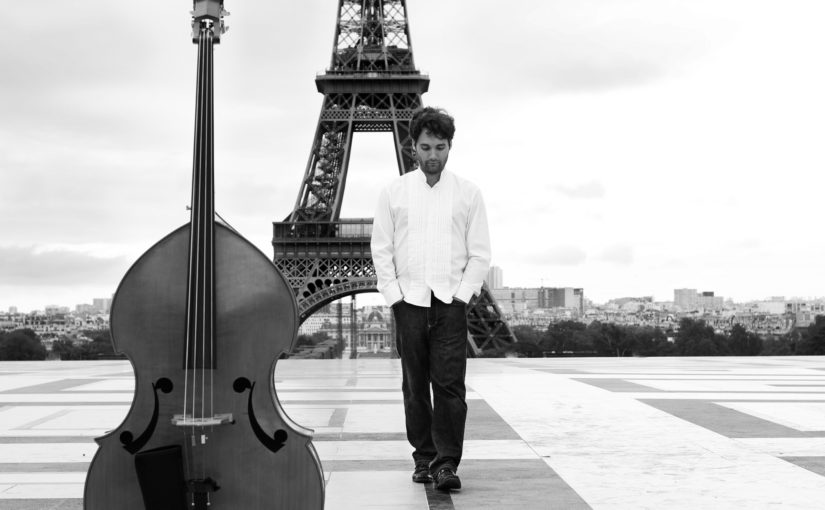
Double bassist and composer Rémy Yulzari is redefining the role of the double bass as a multifaceted solo instrument. Drawing from his personal background, he has developed a unique style that blends a wide palette of colors and genres, all rooted in improvisation and creativity.
On stage, Yulzari also plays accordion, melodica, and piano. He has performed in prestigious venues across the globe—from England to the United States, Israel to Russia, and as far as Taiwan and Japan, as well as at numerous international festivals.
A founding member of several ensembles exploring a wide range of styles, he has released seven albums, including two as a bandleader (Énigme Éternelle, Azafea), and two with his klezmer trio Klezele (Freylekh From Vladivostok, Mosaïque).
He recorded the original soundtrack for the film L’Empreinte with his Quintette Monsolo, and has also recorded two albums of chamber music by G. Onslow and J.S. Bach for the Polynmie label.
Rémy Yulzari holds the French National Teaching Certificate (Certificat d’Aptitude) from the Conservatoire National Supérieur de Musique de Lyon (CNSMD), and an Artist Diploma from the Juilliard School in New York.
He is regularly invited to give masterclasses in double bass, chamber music, and klezmer music, notably in Japan(Koshin RKC Hall) and across France. He currently teaches at the Pôle Supérieur de Paris, succeeding Ibrahim Maalouf.