SONGS FROM THE JUDEO-SPANISH SEPHARDIC TRADITION
INTRODUCTORY WORKSHOP
NOVEMBER 29 TO DECEMBER 2, 2025
AUBAGNE
CONTEXT
While Sephardic songs originated in medieval Spain, they were deeply influenced and enriched by the musical and poetic traditions of the lands where Jewish communities settled in exile after their expulsion from the Iberian Peninsula at the end of the 15th century. This is why an understanding of the neighboring musical traditions is essential to fully grasp the Judeo-Spanish repertoire itself.
The two main geographical areas where the Judeo-Spanish repertoire developed are:
– the western Mediterranean (primarily northern Morocco)
– the eastern Mediterranean and the Balkans (notably cities of the Ottoman Empire such as Thessaloniki, Istanbul, Izmir, Edirne, Sarajevo…)
By regularly inviting musicians and musicologists who specialize in the repertoires of these two regions, we aim to enrich the students’ practice within the program and build bridges between these related musical traditions. This also provides an opportunity for others (including students from other courses) to join in for a masterclass.
This masterclass will allow participants to deepen their familiarity with the diverse poetic and musical world of Judeo-Spanish song, and to explore various vocal (and even instrumental) ornamentation techniques found in the Arab-Andalusian, Ottoman, and Balkan musical spheres—techniques which are often present in certain Judeo-Spanish songs.
APPROACH
The workshop will be conducted primarily orally, and therefore does not require the ability to read music. However, sheet music for the studied songs will be provided whenever possible.
Time will also be devoted to listening to and comparatively analyzing different interpretations of songs using audio recordings.
Participants are welcome to bring recording equipment to help them learn and internalize the songs from one day to the next.
CONTENT
Body preparation and awareness of physical blockages; grounding and fluidity in movement
Vocal warm-ups: focusing on flexibility, agility, ornamentation, and melismas, adapted to the songs being studied and in accordance with their modes
Rhythm work: learning common rhythmic patterns and basic hand percussion techniques to accompany singing
Availability, internalization, attentive listening, and repetition of melodic phrases to absorb the ethos of a mode
Specific work on the art of ornamentation, based on various Judeo-Spanish songs from different branches of the tradition: romances from medieval Spanish tradition, kantigas, coplas
Historical and cultural context, theoretical insights, work on language and interpretation: prosody, pronunciation, and emphasis on words depending on their meaning and the emotion conveyed
SCHEDULE
10:00 AM – 1:00 PM & 2:00 PM – 4:00 PM
PARTICIPATION REQUIREMENTS
A solid singing practice and an interest in the diversity of the repertoire explored (no theoretical knowledge required).
Open to both amateurs and professionals, whether or not they can read music.
Some familiarity, even limited, with Judeo-Spanish (or Spanish) will help save time and improve ease of learning.
Percussion instruments (such as frame drums like the daf) can be loaned by the institute, but participants are welcome to bring their own!
Instrumentalists are also welcome if they wish to accompany themselves and/or perform instrumental interludes from the songs studied.
REGISTER NOW
>> ONLINE REGISTRATION <<
>> FEES AND REGISTRATION DETAILS <<
Biography
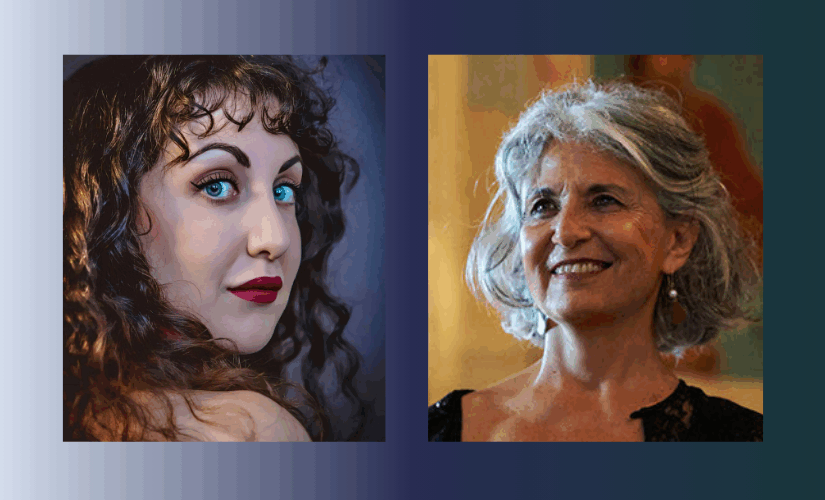
Maria Zopounidis
Maria Zopounidis grew up in Greece, where she was immersed from childhood in a dual musical heritage: her Pontic Greek father passed on to her the traditional songs of Greece, Asia Minor, and the Black Sea, their regions of origin; her Franco-Italian mother, a pianist, taught her piano and gave her a classical music education.
She moved to France to continue her musical studies and obtained in 2018 the Diplôme d’Études Musicales in classical singing at the Conservatoire of Avignon. She continued her training at the Institut Supérieur des Arts de Toulouse, where she graduated in 2022 with the Diplôme National Supérieur Professionnel de Musicien in classical singing, in the class of Sophie Koch and Didier Laclau-Barrère. She also earned a Bachelor’s degree in Musicology at Toulouse Jean Jaurès University and the State Diploma in classical singing. In 2021, she was awarded the “Espoir” Prize at the Maurice Ravel International Academy in Saint-Jean-de-Luz. In 2022, she began her professional singing career with the Capitole National Choir of Toulouse. In 2023 and 2025, Maria performed the role of Susanna in Mozart’s Le Nozze di Figaro at the Nuits Musicales en Armagnac festival.
Her love for orally transmitted early singing led her in 2022 to enroll in the program Sacred and Secular Songs of the Sephardic and Al-Andalus Traditions with Françoise Atlan at the Institut International des Musiques du Monde (IIMM) in Aubagne, where she earned her Diplôme d’Études Musicales in November 2023. Since then, she has taught as an assistant to Sandra Bessis in the IIMM program Songs of the Judeo-Spanish Sephardic Tradition and Related Repertoires. She has also been teaching modern Greek since 2022 in the program Songs of Greece and Asia Minor, directed by Maria Simoglou. Maria also completed a Master’s degree in Musicology at the Jean Jaurès University of Toulouse and presented a paper under the guidance of Florence Mouchet, Associate Professor in Medieval Musicology, at the Modal Music of Yesterday and Today conference held in April 2023 at the Sylvanès Abbey.
Since June 2023, Maria has collaborated with various artists from the world music scene, including Iranian multi-instrumentalist Soroush Kamalian and guitarist Bruno Allary, Artistic Director of Compagnie Rassegna.
Sandra Bessis
Born in Tunisia, Sandra Bessis lived in her native country and several others before settling in France at the age of 18.
Alongside her university studies in literature, she studied singing with Suzy Sachs, then with Françoise Semellaz.
For several decades, she has explored the realm of Sephardic songs and Mediterranean music, performing on numerous stages and festivals in France and abroad. She has also worked on various creative projects with other artists, exploring encounters between musical traditions from across the Mediterranean basin.
Her first album, D’une lointaine Espagne, was released in 1992. With flutist John Mac Lean, she navigates the repertoire of Judeo-Spanish songs with creativity and freedom, playing with timbres and instrumentation.
Her fourth album, Entre deux rives, the result of a live recording at the Synagogue of Carpentras with Rachid Brahim-Djelloul and Anello Capuano, was released in 2005. It marks a kind of return to the roots, blending Sephardic songs with other Mediterranean repertoires, particularly Arabo-Andalusian ones.
In 2006, she created in Paris, together with Rachid Brahim-Djelloul and Noureddine Aliane, a performance that combined fragments of stories, Bouqalat (popular women’s poetry from Algiers), and historical narratives with romances, kantigas, and mouwachahat. A journey between speech, song, and theatricality, traversing once again the paths of transmission across the Mediterranean.
With the ensemble Naguila, she participated in Voyage de Sefarad, a show created in Montpellier in December 2009.
From 2010 to 2013, she was one of the two featured singers in Bratsch’s final production Orient mon Amour, a performance of melodies and poetry from Mediterranean shores. The show, which brought together 17 musicians around poet Salah el Hamdani, was hosted by numerous national venues in France.
Driven by a love for words and the unveiling of intimate speech, she co-created in 2013 at the Théâtre de l’Épée de Bois in Paris, with Mireille Diaz-Florian and accordionist Jasko Ramic, a musical reading titled Toute chose au monde m’est nouvelle. The performance featured texts and poems by Aimé Césaire, Mahmoud Darwich, Saint-John Perse, Anna Seghers, Sophie Bessis, Nancy Huston, and Leïla Sebbar. She later created a solo performance blending storytelling and music, portraying a woman who recalls the traces, shadows, and scents of the Mare Nostrum, the echoes and songs of exiles, and several female figures. Since 2015, this intimate show has been performed more than forty times in France and Italy.
Cordoue 21 – Sur les traces de Sefarad, released in 2014, is her fifth album dedicated to these repertoires.
She brought together Rachid Brahim-Djelloul (violin, vocals), Noureddine Aliane (‘oud, mandole), Jasko Ramic (accordion), Yousef Zayed (percussion, bouzouq), Théo Girard (double bass), and Araik Bakhtikian (duduk) for a new musical journey—freely navigating the Mediterranean Sea and playfully engaging with the identities and languages of its shores.
In December 2022, once again at the Cartoucherie in Paris, she created Ce que leur disent les anges, a musical reading with actress Fatima Soualhia Manet and musician Marius Pibarot. The performance brings together the writings of Annemarie Schwarzenbach, a prematurely lost writer-traveler, and those of singer-poet Patti Smith.
Her concerts are invitations to travel through a musical world rooted in medieval Andalusia and carried forward through the Eastern cultures that inherited its dissolution, resonating with our present time and place.
“With a powerful voice and trembling declamation, Sandra Bessis carries, as a distant legacy, the Judeo-Spanish song of Muslim Andalusia… Her singing in fact embraces the whole Mediterranean, because it is nomadic and ornamented.” — Libération