TRAINING PROGRAM: MUSICAL HERITAGE OF BRAZIL
Samba de Roda, Frevo, Choro
RIO DE JANEIRO / BRAZIL
In partnership with UNIRIO – Universidade Federal do Estato do
Rio de Janeiro
Dates: April 6 – April 12, 2026
Arrival in Rio de Janeiro: April 5, 2026
Classes: April 6 – April 5, 2026
Departure from Rio de Janeiro: April 13, 2026
Total duration: 35 hours (approximately 5 hours per day)
Institutional partnership:
Institut International de Musique du Monde (IIMM) – Universidade Federal do Estado do Rio de Janeiro (UNIRIO)
Academic direction:
Cristiano Nascimento (IIMM) and Pedro Aragão (UNIRIO)
==> Target audience:
Musicians with prior experience in choro or Brazilian popular music.
Training objectives
This program offers an immersion in three emblematic genres of Brazil’s musical heritage, recognized as national and international Intangible Cultural Heritage:
-
Samba de Roda do Recôncavo Baiano – inscribed on the UNESCO List of the Intangible Cultural Heritage of Humanity (2008)
-
Frevo from Pernambuco – inscribed on the UNESCO List of the Intangible Cultural Heritage of Humanity (2012)
-
Choro – recognized as Intangible Cultural Heritage of Brazil (IPHAN, 2024)
Participants will explore the richness and diversity of Brazilian musical practices through their historical roots, community-based forms, and contemporary developments.
The training aims to foster an artistic and pedagogical dialogue between France and Brazil, grounded in oral transmission, collective practice, and cultural understanding of Brazilian popular music.
Teaching team
Almir Côrtes – Samba de Roda do Recôncavo Baiano
Marco Cézar – Frevo (Recife, PE)
Pedro Aragão – Choro (Rio de Janeiro, RJ)
Cristiano Nascimento – Artistic and pedagogical coordination (IIMM – France)
REGISTER NOW
>> ONLINE REGISTRATION <<
>> FEES AND REGISTRATION DETAILS <<
Educational Framework
1. Cultural and Historical Dimension
– Presentation of the historical and social contexts of Samba de Roda, Frevo, and Choro.
– Analysis of processes of cultural blending, resistance, and adaptation.
– Study of institutional recognitions (UNESCO and IPHAN) and their role in preservation and transmission.
– Reflection on the relationship between music, identity, and collective memory in Brazil.
2. Oral Transmission and Living Memory
– Learning through imitation, listening, and participation, following traditional methods.
-Testimonies and stories from the masters: tradition as a lived and shared experience.
– Development of rhythmic perception, auditory memory, and collective interaction.
3. Technique and Collective Practice
– Study of the musical languages specific to each genre:
• Samba de Roda: singing, rhythm, embodiment, improvisation, and community expression.
• Frevo: melodic virtuosity, collective arrangements, and carnival pulse.
• Choro: counterpoint, harmony, improvisation, and instrumental roda.
– Instrumental workshops and ensemble sessions.
– Creation of a shared repertoire integrating the three musical worlds.
4. Immersion and Exchange
– All activities will take place at UNIRIO, within an open academic and artistic environment.
– Exchanges with Brazilian students and teachers.
– Final roda and public presentation at UNIRIO.
Provisional Schedule
Arrival: Sunday, April 5, 2026
Classes: Monday, April 6 – Sunday, April 12, 2026
Departure: Monday, April 13, 2026
| Date / Day | Main Activity |
|---|---|
| Monday, April 6, 2026 (2:00–7:00 p.m.) | Opening session – Presentation of the program and round table on Brazil’s musical heritage with Cristiano Nascimento and Pedro Aragão. |
| Tuesday, April 7, 2026 (10:00 a.m.–1:00 p.m. / 2:30–4:30 p.m.) | Collective workshop: Orality and Transmission – Introduction to the rhythmic principles of Samba de Roda, Frevo, and Choro. |
| Wednesday, April 8, 2026 (5 hours) | Immersion 1 – Samba de Roda (Almir Côrtes). |
| Thursday, April 9, 2026 (5 hours) | Immersion 2 – Frevo (Marco Cézar). |
| Friday, April 10, 2026 (5 hours) | Immersion 3 – Choro (Pedro Aragão). |
| Saturday, April 11, 2026 (5 hours) | Cross workshop: Transversality, Creation, and Interpretation. |
| Sunday, April 12, 2026 (5 hours) | Public presentation and closing roda at UNIRIO. |
Conclusion
Under the direction of Cristiano Nascimento (IIMM) and Pedro Aragão (UNIRIO), this training brings together three masters of traditions recognized by UNESCO and IPHAN. It offers a unique space for transmission, research, and collective creation, allowing musicians to experience a deep immersion in the living musical heritage of Brazil.
Biographies
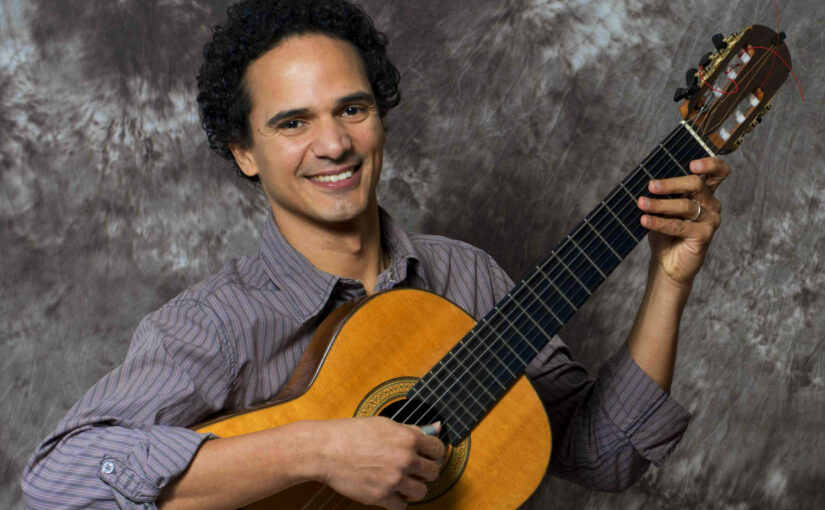
Cristiano Nascimento
Born in Rio de Janeiro, Cristiano Nascimento is a guitarist, composer, and performer of Brazilian music whose musical universe bridges choro, samba, forró, candomblé, and the experimental influences of Hermeto Pascoal.
He discovered music at the age of five in candomblé temples, immersed in traditional rhythms and the sambas of Fundo de Quintal and Zeca Pagodinho.
In 1999, he joined the “New Traditions / Universal Music” workshops led by Itiberê Zwarg, where for five years he followed the creative and pedagogical process of the corpo presente (“present body”) method, refining his technique and deepening his understanding of Brazilian music, between tradition and modernity.
His encounter with Valter Silva in 2003 expanded his instrumental language and enriched his guitar playing. Active in numerous rodas of choro and samba, he has performed alongside major Brazilian artists such as Dona Ivone Lara, Wilson Moreira, Teca Calazans, Fabiana Cozza, Hermeto Pascoal, and Armandinho.
For nearly twenty years, he has served as the artistic director of La Roda Company, together with Claire Luzi — one of the leading promoters of choro in France and Europe.
Recognized for his pedagogical contribution, one of his compositions for solo mandolin was selected for the Brevet d’Études Musicales of the Confédération Musicale de France (CMF) and for the entrance examination of the Conservatoire National de Marseille, attesting to his role in disseminating traditional Brazilian music in France.
His original works for guitar and mandolin are published by Les Productions d’OZ. Since September 2018, he has been a tenured professor of Brazilian music at the Institut International de Musique du Monde (IIMM) in Aubagne, where he also regularly conducts masterclasses.
Pedro Aragão
Professor at the Villa-Lobos Institute of UNIRIO, Pedro Aragão is a researcher specializing in Brazilian popular music, with a particular focus on choro, sound archives, intangible heritage, and Lusophone cultures.
He is the author of O Baú do Animal – Alexandre Gonçalves Pinto e o Choro (Folha Seca, 2014), which received both the Sílvio Romero Prize and the Funarte Prize for Critical Music Production. He also co-authored, with Bia Paes Leme, Paulo Aragão, and Marcílio Lopes, the volumes Pixinguinha Inéditas e Redescobertas, O Carnaval de Pixinguinha, and Pixinguinha Outras Pautas, published in partnership with the Instituto Moreira Salles.
Pedro Aragão was one of the coordinators of the research process that led to the official recognition of choro as Intangible Cultural Heritage of Brazil in 2024 by IPHAN (National Institute of Historic and Artistic Heritage).
As a mandolinist, he has had a distinguished career on the national scene, performing with leading figures of Brazilian popular music such as Cristina Buarque, Roberto Silva, and Mônica Salmaso.
He also coordinated the Escola Portátil de Música project, one of Brazil’s most important choro education centers, from 2005 to 2015.
Marco Cézar
Marco Cézar is a Brazilian composer, arranger, instrumentalist, teacher, and musical director, holding a master’s degree in Music from UFRN. He currently teaches in the postgraduate program in Popular Music – Frevospecialization (IFPE) and at AESO (Phonographic Production program).
He founded the bandolim and cavaquinho departments at the Pernambuco Music Conservatory, where he also teaches.
A recognized specialist in choro and frevo, he serves as musical director and conductor of the Orquestra de Pau e Cordas do Coral Edgard Moraes and is a member of the Academy of Music of Pernambuco.
As an instrumentalist and arranger, he has collaborated with Antônio Nóbrega, the SpokFrevo Orquestra, the Jazz Sinfônica de São Paulo, the Orquestra Sinfônica do Recife, and several popular music ensembles.
He has served as musical director for numerous landmark recordings of Pernambucan music.
Awards:
– Tribute from the Recife City Council for his contribution to choro pernambucano (2023)
– Title of “Personagem Encantado que faz o orgulho de Pernambuco” (“Enchanted Figure Who Makes Pernambuco Proud”) (2024)
– Consultant for the recognition of choro as Brazilian Cultural Heritage (IPHAN, 2024)
Almir Côrtes
Almir Côrtes is a musician specializing in plucked string instruments (mandolin, guitar, Bahian guitar, viola machete, and viola caipira), as well as a composer and researcher. Since 2010, he has performed regularly in the United States, representing Brazil at the Latin Music and Culture Celebration (organized by Berklee College of Music) and serving as an instructor at the Mandolin Symposium in 2011 and 2012.
Originally from Santo Antônio de Jesus in the Recôncavo Baiano region, he holds a bachelor’s degree in Guitar from UFBA, a master’s degree (thesis on the style of Jacob do Bandolim), and a doctorate in Musical Performance (dissertation on improvisation in Brazilian music) from the Institute of Arts at UNICAMP.
In 2005, he won the Best Instrumental Music Award at the III Festival de Música Educadora FM / Bahia with his composition Freveando. He has released six albums and spent over ten years as a member and arranger of the Orquestra Filarmônica de Violas de Campinas.
He has performed in major Brazilian capitals as well as in the United States, Cuba, Argentina, Chile, Colombia, Paraguay, and Europe (Italy, France, and Spain). Notable appearances include the XIV Festival de Música Instrumental da Bahia, Clube do Choro de Brasília, Lotus World Music & Arts Festival, Clube do Choro de Paris, and the Virada Cultural Paulista.
Throughout his career, he has shared the stage with artists such as Nailor Proveta, Armandinho Macêdo, Silvério Pontes, David Grisman, Mike Marshall, Izaías Bueno, Howard Alden, Ivan Vilela, Ronaldo Saggiorato, Harvey Wainapel, João Paulo Amaral, Daniela Spielmann, Gabriel Improta, and Fernando Brandão.
He currently teaches arranging, popular music analysis, and ensemble practice at the Villa-Lobos Institute of UNIRIO, where he also coordinates the Plucked String Orchestra and the web series Villa de Sons.
Contact us for more information: contact@iimm.fr