ARABO-ANDALUSIAN MUSIC
FEBRUARY 28 TO MARCH 4, 2026
AUBAGNE
DETAILED PEDAGOGICAL CONTENT
Day 1
10:00 AM – 1:00 PM:
Getting to know the participating musicians.
Introduction covering some historical and sociological aspects, discussion of poetry, orality, and the instrumentarium. Also provide some context about the practice of musique Arabo-andalouse in Maghreb countries.
Begin theoretical concepts through the first tab’ studied: raml-maya, and its inqilab ya qelbi khellil hal.
2:00 PM – 4:00 PM:
Continue working on the inqilab ya qelbi khellil hal, focusing on ornamentation, and move on to improvisation through the istikhbar and its codification.
Day 2
10:00 AM – 1:00 PM:
Tab’ sika: structure and characteristics. Work on the inqilab sûltanû lmahebbati mûnçifi.
2:00 PM – 4:00 PM:
Work on istikhbar (improvisation) sika and review the inqilab.
Day 3
10:00 AM – 1:00 PM:
Tab’ moual: structure and characteristics. Work on the inqilab zarani lmalih ouahdou.
2:00 PM – 4:00 PM:
Work on istikhbar (improvisation) moual and review the inqilab.
Presentation of the work accomplished since the beginning of the workshop.
PARTICIPATION REQUIREMENTS
Open to both female and male singers. In keeping with tradition, singing is also encouraged for instrumentalists.
Open to instrumentalists with a minimum of three years of practice (solid instrumental proficiency required).
Instruments:
ʿÛd, kouitra, qânûn, fhel (ney), percussions (târ, derbûka), as well as equivalent instruments from Ottoman or Persian traditions.
More recent instruments adopted in the Maghreb such as the violin, viola, cello, or mandolin are welcome, as well as medieval instruments like the rebec, Celtic harp, and recorder.
REGISTER NOW
>> ON-LINE REGISTRATION <<
>> RATES AND REGISTRATION PROCEDURE <<
BIOGRAPHY
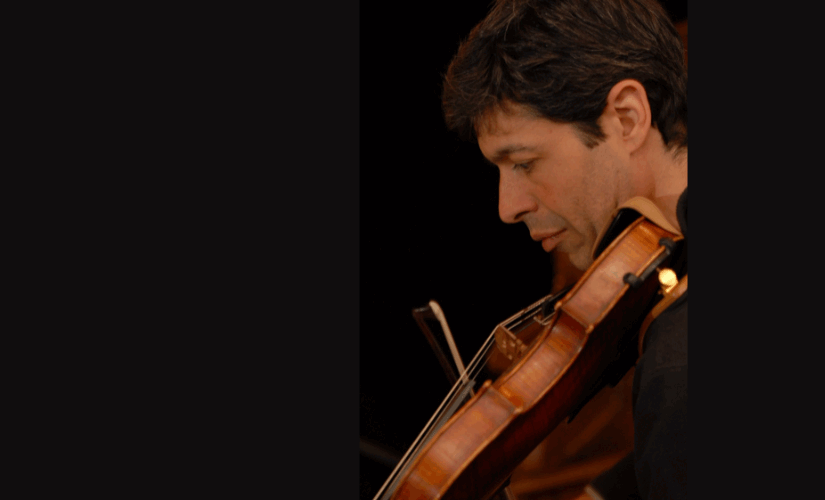
Born in Algiers, Rachid Brahim-Djelloul earned first prizes in violin and chamber music at the Algiers Conservatory, as well as a degree in musicology. He continued his theoretical and practical training in France, completing a master’s degree in musicology and a postgraduate degree (DEA) in aesthetics, arts sciences and technologies. He also received a Violin Prize and a Chamber Music Excellence Award from the Conservatoire National de Région (CNR) in Rueil-Malmaison.
Rachid Brahim-Djelloul has performed with numerous symphonic orchestras. He has also appeared as a soloist and chamber musician with the Hypoténuse String Quartet. A highly skilled traditional music performer as well, he has been heard with the ensemble El Mawsili (an Arabo-Andalusian music orchestra), Emmanuelle Drouet, Simon Elbaz, and Enrico Macias, among others. He has also contributed to theatrical productions by Slimane Benaïssa, notably Prophètes sans dieu, which enjoyed great success in French-speaking countries. His collaborations have taken him to concert halls across Europe, Africa, and Canada.
He has participated in many recordings, spanning classical and traditional music, as well as jazz and popular music. His discography includes recordings alongside Sandra Bessis, Enrico Macias, Nassima, Michel Deneuve, François Méchali, Idir, Takfarinas, Chérif Kheddam, and Adamo. As a musicologist, he regularly takes part in conferences and radio programs both in France and internationally, presenting his research on traditional music from the Mediterranean region. In 2004, he participated in a symposium in Cyprus, the proceedings of which were published under the title Linguistic Borrowings, Cultural Imprints. He also contributed to two publications: one on Algerian popular music known as Châabi(published by El-Ouns/UNESCO), and another on Arabo-Andalusian music (an interactive CD published by El Ouns).
Drawing on this rich experience, Rachid Brahim-Djelloul naturally went on to found the ensemble Amedyez, through which he aims to showcase the diversity and richness of a multifaceted Mediterranean heritage—one deeply rooted in shared resonances. The ensemble’s first project was a performance created with his sister, Amel Brahim-Djelloul.
Finally, he founded a violin class at the ENM (École Nationale de Musique) in Gennevilliers, where he has been teaching Mediterranean traditional music since 2005.