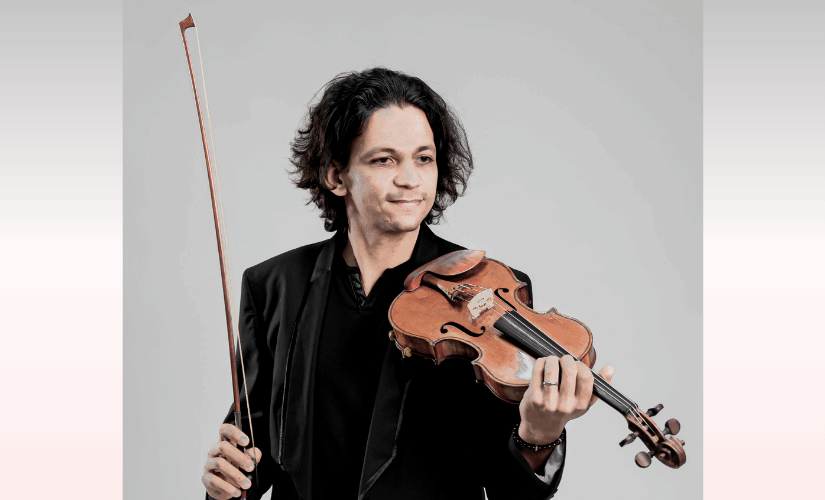
ARAB-ORIENTAL VIOLIN: IMPROVISATION
AND COLLECTIVE COMPOSITION
JUNE 8 TO 12, 2026
AUBAGNE
CONTEXT
This master class is part of the ongoing journey of my experience as a solo violinist, centered on oral transmission, Arab-Oriental modality, and its connections with new global musical aesthetics. This program highlights the musical nuances of the Mediterranean region, embracing the challenge of interculturality and offering wide space for improvisation.
It is a reflection that began about fifteen years ago and has been constantly nourished by encounters and discussions with musicians from various oral traditions. These sessions now foster communication between artists seeking new horizons, inviting them to meet, exchange, find common ground, and reinvent themselves through contact with others.
In various music education systems, including those in the East, there is a common belief that intelligence must be expressed through writing. While not untrue, this idea is extremely limiting. This master class invites participants to immerse themselves in orality, to develop skills and abilities they may not usually have the chance or opportunity to express in their own cultures or geographic regions. In a context of total openness and freedom—which defines the essence of this master class—they will be able to unlock and develop their innate qualities.
Zied Zouari
REGISTER NOW
>> ON-LINE REGISTRATION <<
>> RATES AND REGISTRATION PROCEDURE <<
EDUCATIONAL CONTENT
Three main areas, including one theoretical and two practical:
-
AXIS 1: Exploration and assimilation of Arabic modality, discovering the maqām system (Arabic musical modes), their microtonal scales and characteristic melismas through the violin.
-
AXIS 2: Violin practice of the various modes and scales of Arabic music, opening the way to connections between different Eastern musical traditions covered, ranging from the Maghreb to India.
-
AXIS 3: Improvisation & collective composition, questioning listening dynamics, the tension/release duality, and the inner score—a set of phenomena that stimulate inventiveness and creativity.
The first axis is foundational and will provide new knowledge or validate and deepen existing concepts related to maqām music. This part of the training focuses on assimilating what I call the “Generative Scale of Arabic Music,” from which the main Arabic maqāms are derived.
The second axis delves into the practice of Arab-Oriental violin in its rhythmic and melodic dimensions. It involves specific scenarios in various contexts in order to understand how the system works and acquire the necessary language elements for each repertoire. It also includes the acquisition of typical ornamental techniques by highlighting the associated microtones and melismas.
The third axis, the most important one, is dedicated to violin improvisation and collective composition. In this framework, collective composition serves as a vehicle to significantly support and enhance improvisational skills. This liberation from written music also offers the opportunity to conceive violin playing from a radically different perspective. My approach thus aims to challenge certain assumptions and unlock new creative processes related to modality and rhythm.
This master class establishes a set of mechanisms that allow for the acquisition of foundational knowledge and practical skills specific to Arab-Oriental violin. It also encourages imagining new pathways for creation through collective composition.
OBJECTIVE
Assimilate and recognize the main maqāms of Arabic music
Build and develop a coherent musical discourse through improvisation
Get introduced to microtones
Approach the main ornamental techniques of Arab-Oriental violin with contextual applications for each geographical area studied
Stimulate the inner score by optimizing listening and pushing memory boundaries
Apply the basics of polyrhythm by stabilizing the internal clock
Perceive tension/release phenomena within the maqām system
Develop individualized strategies for musical exploration according to each participant’s background